
Craft Guide | nari18.com | Craft Guide | Nari18 Journal | July 2026
What is Chikankari Embroidery? The Complete Guide to India's Most Beloved Handcraft
By Nari18
Published 13 min read
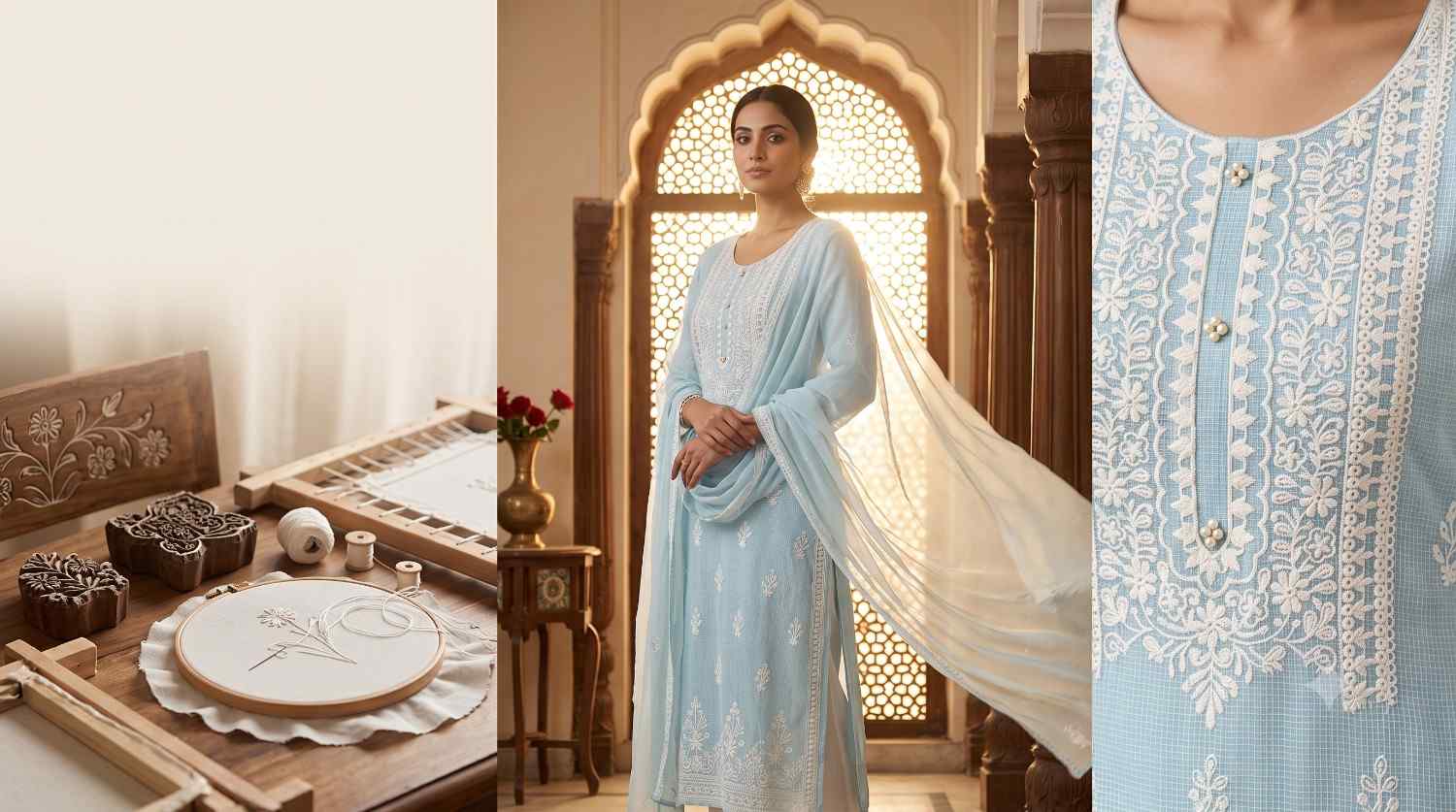
Walk into any serious ethnic wear boutique in India and you will find it — white threadwork on pale fabric, creating patterns so intricate they look more like lace than embroidery. Delicate, disciplined, unmistakably Indian. This is Chikankari: a hand-embroidery tradition from Lucknow, Uttar Pradesh, that has been practiced continuously for over four centuries and remains one of the most technically demanding and beautiful craft forms produced anywhere in the world.
At Nari18, Chikankari work is among our most popular offerings — woven into Georgette, Muslin, and Cotton suit sets that we source directly from Lucknow's embroidery artisans. Over the years, one question has come up more than any other: what exactly is Chikankari, how is it made, and how can you tell real hand-done Chikankari from the machine-printed imitation that has flooded the market?
This guide answers all of it. The history, the craft, the stitches, the fabrics, and how to make sure you are buying the real thing.
The short answer: Chikankari is a hand-embroidery technique from Lucknow that uses white or self-coloured thread on light fabrics to create intricate floral, paisley, and botanical patterns. It uses over 30 different stitch types, each requiring years of practice to master. Authentic Chikankari is done entirely by hand — one stitch at a time.
1. The History of Chikankari — From Mughal Courts to Modern Wardrobes
The word "Chikankari" is believed to derive from the Persian word "chikan" — meaning embroidery work. Its origins in India are most directly traced to the Mughal period, specifically to the court of Emperor Jahangir in the 17th century. The most popular origin story credits Nur Jahan, Jahangir's wife, with introducing or patronising the craft — though historians note that shadow-style embroidery on fine cotton was practiced in Bengal before the Mughal period, and the Lucknow form may be a refined evolution of that earlier tradition.
What is certain is that by the 18th century, Chikankari had become firmly associated with Lucknow — then the capital of the Nawabs of Awadh, a court culture famous for its refinement, its architecture, its cuisine, and its patronage of the arts. The Nawabi court demanded embroidery of extraordinary delicacy: white thread on white or near-white muslin, creating patterns visible primarily in the texture of the work rather than through colour contrast. This aesthetic — restrained, technically demanding, beautiful in a way that rewards close attention — defined what Chikankari became.
Through the British colonial period, the craft survived and adapted, eventually finding a broader market through trade. Today, Chikankari is a multi-billion rupee industry centred in Lucknow, employing hundreds of thousands of artisans — predominantly women working from home — and producing everything from casual cotton kurtas to elaborate formal Georgette suit sets worn at weddings.
Today the Chikankari industry in Lucknow employs over 1.5 million artisans, making it one of the largest craft clusters in India. The majority of artisans are women who work from their homes, embroidering fabric that is brought to them by contractors and collected after completion.
2. How Chikankari is Made — The Process from Fabric to Finished Suit
Authentic hand-Chikankari is a multi-stage process involving different specialists. Understanding these stages is the best way to understand why genuine Chikankari costs more than machine-printed imitations — and why it is worth it.
Stage 1 — Block Printing the Pattern
Before a single stitch is made, the design is transferred onto the fabric using carved wooden blocks and a water-soluble dye. The block printer — traditionally called a chhapai wala — stamps the floral, paisley, or botanical outline across the kurta panel, bottom, and dupatta. This printed guide is temporary; it washes out after the embroidery is complete.
Stage 2 — Hand Embroidery
This is the heart of the craft. The printed fabric is distributed to embroiderers — usually women working from home in Lucknow's craft colonies — who stitch the design by hand, stitch by stitch. A high-quality Georgette suit set can take one to two weeks of focused work to finish. Different sections may use different stitch families: base stitches for outline, shadow stitches for the signature Chikankari glow, and surface stitches for texture and fill. No two hand-embroidered pieces are identical.
Stage 3 — Washing
Once embroidery is complete, the fabric is washed to remove the printed guide pattern. Washing also helps the embroidery settle into its final texture — the threads soften slightly into the weave, and the shadow-work effect becomes clearer on sheer fabrics.
Stage 4 — Finishing
The final stage involves pressing, inspection, trimming loose threads, and matching the three pieces — kurta fabric, bottom fabric, and dupatta — for packaging. Quality houses check stitch density, consistency across panels, and overall finish before a set leaves the workshop.
3. The Stitches of Chikankari — What Makes This Craft So Complex
What sets Chikankari apart from most other embroidery traditions is the sheer number of distinct stitch types it employs, and the years of practice required to execute each one correctly. There are over 30 recognised Chikankari stitches. Here are the most important ones.
| Stitch Name | Technique | Visual Effect |
|---|---|---|
| Tepchi | Long running stitch done on the right side of fabric | Creates the outline of the design — the most basic Chikankari stitch |
| Bakhiya (Shadow Work) | Herringbone stitch worked on the wrong side of sheer fabric | Creates a shadow effect visible through the fabric — the most recognisable Chikankari technique |
| Murri | Tiny knot stitch creating a seed-like raised dot | Creates dense, textured fill patterns — exceptionally time-consuming to execute |
| Phanda | Even tinier than murri — precise oval knot | Creates fine-grained texture in petals and leaves — requires exceptional precision |
| Jaali (Drawn Thread Work) | Warp and weft threads pulled aside to create open mesh | Creates lace-like open sections — most complex Chikankari stitch type |
| Zanzeera | Chain stitch worked in a chain-link pattern | Creates linked borders and outlines with a heavier visual weight |
| Keel Kangan | Raised satin stitch creating a bracelet-like border | Dense raised embroidery with a jewellery-like quality |
| Rozan | Flat satin stitch used to fill solid areas | Creates smooth, solid fills in petals and leaves |
The most prized Chikankari pieces combine multiple stitch types — shadow work in the background, murri and phanda for texture, jaali for decorative openwork, and surface stitches for detail. A piece that uses only tepchi (the outline stitch) and bakhiya is considered basic. A piece that incorporates murri, phanda, and jaali alongside shadow work is at the highest level of the craft.
4. Fabrics for Chikankari — Which Base Works Best
Chikankari can technically be worked on any fabric with a fine enough weave, but certain fabrics are considered traditional and produce the best results.
Georgette — The Current Favourite
Pure Georgette is the most popular contemporary base for Chikankari work. Its characteristic crinkle texture holds the embroidery firmly without stretching, the slight transparency works beautifully with shadow-stitch (bakhiya) work, and the fluid drape of Georgette fabric makes a Chikankari Georgette suit set hang with particular elegance. The movement of Georgette as you walk carries the embroidery in a way that flat fabrics cannot.
At Nari18, our Georgette collection includes Chikankari suit sets in powder blue, dusty rose, ivory, and sage green — each embroidered by artisans from the Lucknow cluster. The embroidery on these pieces uses a combination of bakhiya, tepchi, and murri to create the distinctive layered appearance of quality Chikankari.
Shop Nari18 Chikankari Georgette Suits → nari18.com/catalog/georgette
Muslin — The Traditional Base
Muslin (and specifically the very fine Mul cotton) was the original base fabric for Chikankari during the Mughal period. Its transparency made shadow-work (bakhiya) especially effective — the stitching done on the wrong side of the fabric would glow through the weave on the right side, creating the characteristic ghostly floral patterns of traditional Nawabi Chikankari. Fine Muslin Chikankari suits are among the most traditional and most prized pieces in the craft.
Shop Nari18 Muslin Suits → nari18.com/catalog/muslins
Cotton — The Everyday Chikankari
Pure cotton is the most widely available base for Chikankari work, and the most practical for everyday and summer wear. Cotton Chikankari suits are breathable, machine washable, and significantly more affordable than Georgette equivalents. The embroidery on cotton tends to use more surface stitches and less shadow work, because the opacity of cotton does not show the bakhiya effect as clearly.
Shop Nari18 Cotton Suits → nari18.com/catalog/cotton-suits
5. How to Identify Real Hand-Done Chikankari — The Six Tests
The market is flooded with machine-printed Chikankari imitations. They look similar from a distance but feel and wear completely differently, and they do not support the artisan communities that make the genuine craft possible. Here is how to tell the difference.
- Check the back of the fabric: The single most reliable test. Flip the fabric over and look at the back. Hand Chikankari will show the underside of the stitches — slightly messy, with thread tails and different stitch tension visible. Machine-printed Chikankari has an absolutely identical back, or no visible stitch work at all because the pattern is printed, not embroidered.
- Look for shadow work (bakhiya): Hold the fabric up to light. Genuine shadow-stitch Chikankari on sheer fabric (Georgette or Muslin) will show the stitching from the wrong side as a shadow visible through the weave. Machine prints on the right side only cannot replicate this.
- Touch the texture: Real Chikankari has a physical texture you can feel with your fingers — the raised knots of murri and phanda stitches, the slight ridges of the chain stitch, the different surface levels of multi-stitch work. Machine-printed work is flat to the touch.
- Look for inconsistency: This sounds counterintuitive, but subtle inconsistency is a mark of authentic hand embroidery. Stitch spacing that varies very slightly, petals with slightly different density, the faintest variation in thread tension from one flower to the next — these are hallmarks of human craft. Perfect regularity = machine production.
- Check thread ends: On the back of hand Chikankari, you will see small thread ends where the embroiderer began and finished a section. Machine-made pieces have no such thread ends.
- Ask about the source: A brand selling genuine Chikankari will know where their pieces come from. At Nari18, our Chikankari suits are sourced directly from Lucknow artisans. We can tell you the specific embroidery technique used on each piece because we know the people who made them.
6. Caring for Your Chikankari Suit — What You Must Know
Chikankari suits require slightly more careful handling than plain fabric suits, particularly if the base fabric is Georgette or Muslin. Here is how to keep your Chikankari embroidery in perfect condition.
- Hand wash in cold water: Always hand wash Chikankari suits in cold water with a very mild detergent. Never use hot water — it can cause the embroidery thread to shrink or pucker, and can damage the dyes used in coloured Chikankari.
- Turn inside out before washing: Washing the fabric inside-out protects the surface embroidery from abrasion and prevents delicate stitches from catching on other clothing or the washing basin.
- Never wring: Gently press out excess water. Wringing a Chikankari suit — especially on fine Georgette — can distort the fabric and damage the shadow-work stitching.
- Dry in shade: Hang to dry away from direct sunlight. Sunlight causes yellowing in white Chikankari thread over time.
- Iron on reverse: Iron the suit on the wrong side, with a cloth between the iron and the fabric. Direct high-heat ironing can flatten murri and phanda knot stitches permanently.
- Dry clean for heavily embellished pieces: Suit sets with murri, phanda, and multi-stitch Chikankari work are best dry cleaned for the most careful preservation of the embroidery texture.
7. Frequently Asked Questions About Chikankari
| Question | Answer |
|---|---|
| What is Chikankari embroidery? | Chikankari is a traditional hand-embroidery technique from Lucknow, India, that uses fine white or self-coloured thread on light fabrics to create intricate floral, paisley, and botanical patterns. It dates to the Mughal period and uses over 30 distinct stitch types. |
| What is the difference between Chikankari and regular embroidery? | Chikankari is a specific regional tradition with its own stitch vocabulary — particularly shadow-work (bakhiya), knot stitches (murri and phanda), and drawn threadwork (jaali). These techniques are specific to the Lucknow tradition and not used in the same combination in other embroidery styles. |
| How can I tell if Chikankari is hand-done or machine-made? | Turn the fabric over and look at the back. Hand Chikankari shows the underside of stitches — slightly irregular with visible thread. Machine-printed Chikankari has a perfectly clean back or no stitch work at all because the pattern is printed, not embroidered. |
| Which fabric is best for Chikankari suits? | Georgette is the most popular contemporary base — it holds embroidery well and its crinkle texture pairs beautifully with shadow-work. Muslin is the traditional base and creates the most authentic Nawabi look. Cotton is the most practical for everyday and summer wear. |
| What is the most complex Chikankari stitch? | Jaali (drawn threadwork) is considered the most complex — warp and weft threads are pulled aside to create a lace-like open mesh. It requires exceptional precision and takes the most time to complete. Murri and phanda (knot stitches) are also highly skilled work. |
| Where can I buy authentic Chikankari suits online in India? | At Nari18, our Chikankari suit sets are sourced directly from Lucknow artisan clusters. We carry Chikankari in Georgette, Muslin, and Cotton across multiple colour combinations. Custom stitching available — shop at nari18.com/catalog/georgette or WhatsApp +91 8826446755. |
| How do I wash a Chikankari suit? | Hand wash in cold water with mild detergent. Turn inside out before washing. Never wring. Dry in shade away from direct sunlight. Iron on the reverse side with a cloth between iron and fabric. Dry clean for heavily embellished pieces with murri or phanda work. |
Final Thoughts — Why Chikankari Belongs in Every Indian Wardrobe
Chikankari is not just embroidery. It is a living link to four centuries of Indian craft tradition — carried forward by hundreds of thousands of artisans, predominantly women, who have learned it from their mothers and grandmothers and now practice it from their homes in Lucknow's craft colonies. Every stitch in a hand-done Chikankari suit represents time, skill, and a cultural knowledge that is genuinely irreplaceable.
When you wear Chikankari, you are wearing something made with a combination of technical skill, cultural knowledge, and deliberate artistry that no machine can fully replicate. The value of that is not measured only in the beauty of the finished piece — it is also in the supply chain behind it, the artisans who produced it, and the tradition that has been kept alive through their work.
At Nari18, every Chikankari suit in our collection is sourced from Lucknow artisans and available as an unstitched set with custom stitching through our in-house tailoring service. Browse the collection at nari18.com, or WhatsApp us at +91 8826446755 to discuss any piece in detail.
Shop Nari18's Chikankari Collection → nari18.com/catalog/georgette